
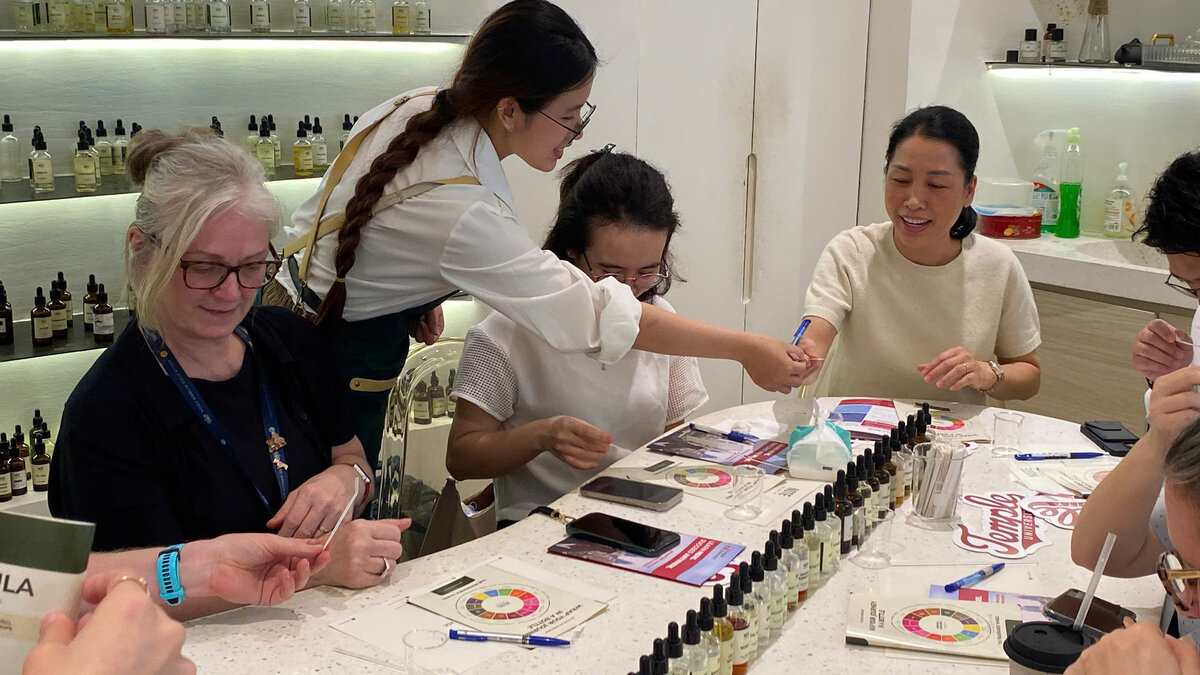

What are the scents of Hanoi? NOTE – The Scent Lab is a perfume workshop in Hanoi, Vietnam, located inside Lotte Mall Tây Hồ (★4.9, 500+ reviews). As perfumers who work with Vietnamese ingredients daily, we know Hanoi’s invisible scent landscape intimately — lotus rising from West Lake at dawn, jasmine tea steeping in a 100-year-old house, pho broth simmering before the city wakes, trầm hương (agarwood) drifting from a pagoda courtyard, and hoa sữa (milk flowers) turning every October evening into something you’ll never quite forget.
Stand on the Thanh Niên causeway at 5:30 a.m. The air is cool — cooler than you expected. Mist hangs low over West Lake. Then the lotus hits. Not faint, not decorative. It rises from the water in waves — green, sweet, almost aquatic — the scent of a thousand years of Vietnamese poetry made physical. Fishermen drag nets through it. Monks on the far shore are already burning incense. And somewhere behind you, the first pho stall on Phố Yên Phụ lifts its lid.
This is a scent map of Hanoi. For the companion piece covering Saigon’s aromatic landscape, see what does Saigon smell like. Not the Hanoi you see in travel guides — the Hanoi you smell. We wrote it because we are perfumers, and scent is our language, and Hanoi speaks it fluently.
Sen (Lotus): The Soul Scent of Hanoi
Every city has a signature scent. For Hanoi, it is lotus — sen. Not the polite, dried lotus you might know from a tea box. Living lotus. Rising from the lakes that define this city’s geography and spirit.
West Lake (Hồ Tây) is the largest, and from June through August, its lotus fields bloom in staggering abundance. The scent is complex: green and slightly metallic at first encounter, then opening into a honeyed sweetness with a waxy, almost creamy base. In perfumery terms, lotus is a heart note — it doesn’t shout, but once you notice it, everything else arranges itself around it.
Vietnamese lotus has a quality that distinguishes it from Egyptian or Indian varieties: a freshness that feels alive, vegetal, connected to water and mud. When we use Vietnamese lotus extract in our perfume workshop at Lotte Mall Tây Hồ, guests often pause. They recognize it — from the lake they walked past that morning, from the lotus tea they drank at breakfast. The ingredient and the memory collapse into one.
Lotus is not just a flower in Hanoi. It is the national flower of Vietnam, a Buddhist symbol of purity, and the ingredient in one of the city’s most treasured traditions: trà sen (lotus tea). In the Tây Hồ district, artisans still practice the centuries-old technique of placing green tea inside lotus buds at dusk, allowing the petals to close overnight, infusing the leaves with fragrance. One kilogram of lotus tea requires 1,000 to 1,400 lotus flowers. The result smells like patience itself.
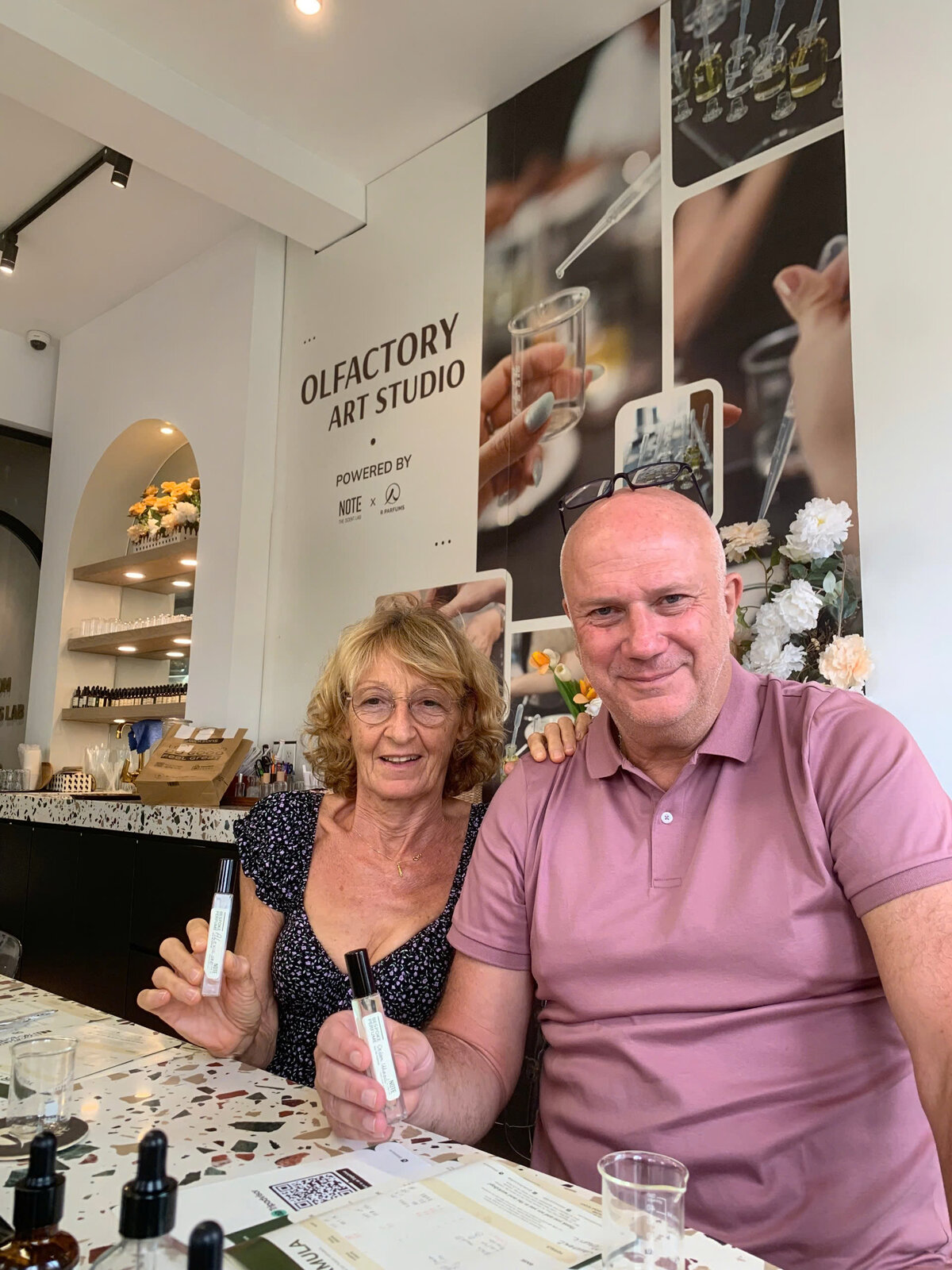
“This is a not-to-miss experience! We enjoyed every moment. Vy was so helpful and taught us so much about scent pairing. I will do this again when I’m in Hanoi!”
Trà (Tea): Hanoi’s Quiet Aromatic Ritual
If lotus is Hanoi’s soul, tea is its daily breath. The city runs on trà — not the grab-and-go kind, but the sit-down, pour-slowly, talk-about-nothing kind. And the scent of tea here is different from anywhere else.
Walk through the Old Quarter — our Hoan Kiem Lake walking guide covers this area in detail — Phố Hàng Buồm, Hàng Điếu — and you will find tea shops that have operated for three, four generations. The air inside carries dried jasmine flowers, roasted green tea leaves, and the faint mustiness of wooden chests where tea has been stored for months. It is warm, papery, vegetal. It smells like a library where every book is edible.
Hanoians drink trà đá (iced tea) on tiny plastic stools, trà sen (lotus tea) in ceremony, trà xanh (green tea) with every meal. Each carries a different olfactory signature. Trà đá is clean and faintly astringent. Trà sen is layered — floral over vegetal over mineral. Trà xanh is grassy and bright, almost like freshly cut bamboo leaves.
In our workshop, we talk about tea as a fragrance family: the way green tea functions as a fresh top note, the way jasmine tea bridges floral and herbal categories, the way aged pu-erh tea becomes a base note — smoky, earthy, almost animalic. Hanoi taught us this. Every cup is a lesson in composition.
Phở: The Perfume Hanoi Wears Before Dawn
Hanoi’s most famous scent is also its most misunderstood. Phở is not simply soup. It is a perfume that the city puts on before the sun rises.
The broth begins simmering at 2 or 3 a.m. — beef bones, charred ginger, charred onion, star anise, cassia cinnamon, cardamom, clove. Each spice contributes a different note. Star anise is the top: sweet, licorice-bright, immediately recognizable. Cinnamon is the heart: warm, slightly woody, sustained. The base is bone marrow — rich, umami, collagen-heavy, creating the mouthfeel that separates real phở from imitation.
Walk down Phố Lý Quốc Sư or Phố Bát Đàn before 7 a.m. and you will smell it from half a block away. The steam rises from enormous pots and mingles with the cool morning air, creating visible clouds of fragrance. In perfumery, we call this sillage — the trail a scent leaves in its wake. Phở has extraordinary sillage. It follows you through the alley, clings to your jacket, and hours later, you catch a ghost of star anise and think: that was breakfast.
When international guests arrive at our Lotte Mall Tây Hồ studio with this scent still on their sleeves, we sometimes begin the workshop there. “What did you eat this morning?” The answer is always phở. And then we show them the raw spices — the same star anise, the same cassia bark — arranged among our 30+ blending ingredients. The city and the workshop are the same conversation. You can explore these connections hands-on at our Hanoi perfume workshop at Lotte Mall.
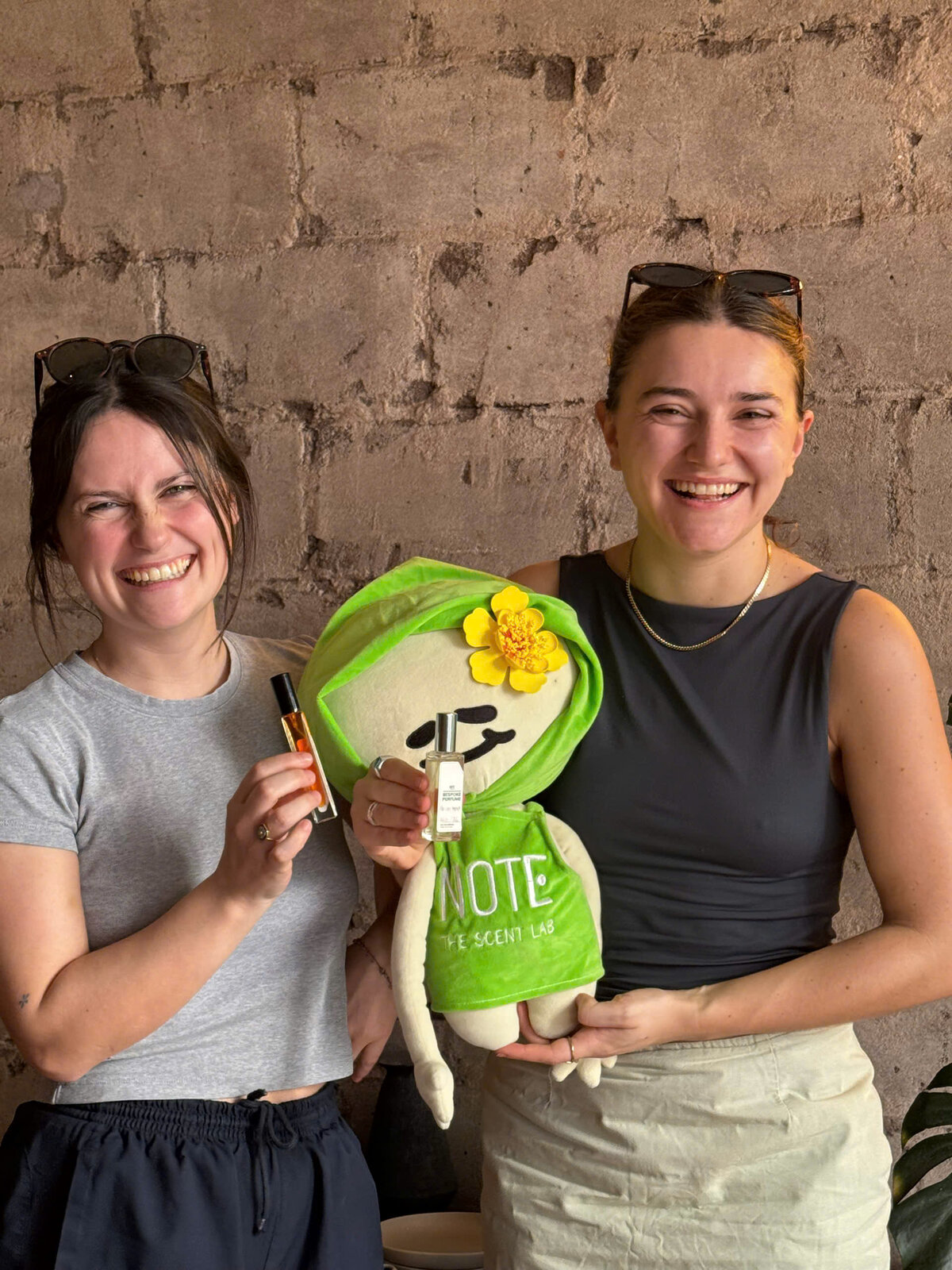
Hanoi customers tend to take longer choosing their base notes. Something about the city’s pace gets into the blending process — unhurried, deliberate, contemplative.
Trầm Hương (Agarwood): Hanoi’s Sacred Base Note
Beneath every other scent in Hanoi, there is trầm hương. Agarwood. Vietnam’s most precious aromatic material, burned in pagodas, temples, and homes across the city for centuries.
Visit Trấn Quốc Pagoda on a quiet afternoon — West Lake behind you, 1,500 years of history before you — and the air is thick with agarwood smoke. Not overwhelming. Contemplative. The scent is woody, leathery, slightly smoky, with a sweetness that emerges over minutes, not seconds. High-grade Vietnamese agarwood (trầm hương) sells for more than gold by weight. It is the base note of Vietnamese spirituality.
Agarwood is produced when Aquilaria trees respond to a specific fungal infection by creating dark, aromatic resin. Vietnam is one of the world’s premier sources, and the material has been part of Vietnamese culture since the Champa kingdom traded it along maritime silk routes a thousand years ago. Burning agarwood is how Vietnamese families honor ancestors, mark lunar new year, and create sacred space in ordinary rooms.
In our workshop, we work with Vietnamese agarwood essence. It is one of the ingredients guests are most drawn to — partly because of its depth, partly because they’ve been smelling it all day in Hanoi without knowing its name. The moment of recognition — this is what that was — is one of the most powerful things we witness.
“Such a fun experience — learned so much about perfume and the staff were so patient and knowledgeable, especially Sophia. Now have a great keepsake from our Hanoi trip!”
Hoa Sữa (Milk Flower): October’s Invisible Perfume
Ask any Hanoian what autumn smells like, and they will say the same word: hoa sữa. Milk flower. Alstonia scholaris. A tree-borne blossom so intensely fragrant that it alters the emotional temperature of the entire city every October.
Hoa sữa is planted along many of Hanoi’s boulevards — Nguyễn Du, Phan Đình Phùng, Hoàng Diệu. When it blooms, usually from late September through November, the scent is inescapable. Milky, sweet, slightly heady, with a jasmine-adjacent quality that perfumers classify as white floral. At night, the fragrance intensifies. Walking under hoa sữa trees after dark, in the cool autumn air, is one of Hanoi’s most visceral sensory experiences.
For Vietnamese people, hoa sữa is nostalgia crystallized. It is linked to school memories (the trees line many school compounds), to first loves, to the particular melancholy of Hanoi autumn. Songs have been written about it. Poems fill anthologies. It is perhaps the only flower in Vietnam whose scent, not its appearance, defines its cultural meaning.
If you visit Hanoi between October and November, you will understand. The scent finds you on a motorbike ride, through a taxi window, while sitting at a lakeside trà đá stall. It requires no effort. It simply arrives.
The Old Quarter: Spice, Steel, and Street Cooking
Hanoi’s Old Quarter is 36 streets, each historically dedicated to a single trade. The naming convention persists — Phố Hàng Gai (silk), Hàng Bạc (silver), Hàng Mã (paper goods) — and so do the scents.
Hàng Buồm is spice territory. Cinnamon bark in burlap sacks. Star anise loose in baskets. Dried ginger, turmeric root, black cardamom pods blackened by smoke. The air is warm and prickling, like inhaling a spice rack. Hàng Đường (sugar street) smells of caramelized mạch nha (maltose) and ô mai (preserved fruit) — sweet, tangy, slightly medicinal.
But the Old Quarter’s most persistent scent is street cooking. Bún chả charcoal grills send smoky, caramelized pork through alleyways on Hàng Mành. Egg coffee (cà phê trứng) at Café Giảng combines roasted robusta with whipped egg yolk — the steam smells like a dessert pretending to be a coffee. Bánh mì carts on every corner release the yeasty, rice-flour-light scent of Vietnamese baguettes, different from French bread — crispier, airier, more popcorn than butter.
At night, the quarter transforms. Beer joints on Tạ Hiện street fill the air with bia hơi (fresh beer) — light, almost bread-like — and grilled squid, grilled corn, and the sweet charcoal of burning sugarcane. It is a neighborhood that changes its perfume hourly.
Bottling Hanoi: From Scent Memory to Signature Perfume
Here is what we know after years of running perfume workshops in Hanoi: every visitor carries the city’s scents before they walk through our door. Lotus from the lake. Tea from the morning cup. Phở from breakfast. Incense from a pagoda visit. Hoa sữa, if they are lucky enough to come in October.
The workshop takes 90 minutes. You sit with a workshop instructor — one human being guiding another through 30+ professional-grade ingredients, including Vietnamese specialties like lotus, agarwood, cinnamon, and lemongrass. There is no right answer. There is no wrong scent. There is only your nose, your memory, and the ingredients before you.
What happens, consistently, is this: guests reach for the ingredients they’ve been smelling all week without realizing it. The star anise that was in their phở. The cinnamon from the Old Quarter. The lotus from West Lake. The workshop does not teach you about fragrance — it reveals what Hanoi has already taught you.
You leave with a custom Eau de Parfum bottle (or explore NOTE’s ready-made collection if you want a second bottle), your own formula card (stored by NOTE for reordering — you can reorder when you return to Vietnam), and something less tangible: the understanding that scent is memory made portable. Every spray is a return ticket.
“The staff is very informative and patient. I’m so proud of coming up the scent I really like even though it’s my first time. A must try in Hanoi.”
Secure your Hanoi session online — you will receive instant confirmation with no deposit. Credit card, bank transfer, and cash on the day are all accepted.
Book Your Perfume Workshop in Hanoi →
A Seasonal Scent Calendar for Hanoi
Hanoi is not Saigon. It has seasons — real ones — and each changes the city’s olfactory identity.
Spring (February–April): Hoa đào (peach blossom) for Tết, wet earth after winter drizzle, lemongrass in warming soups. The air is damp and cool. Scents are muted, intimate, close to the skin.
Summer (May–August): Lotus season. Frangipani and jasmine in full bloom. Tropical fruit — lychee from Bắc Giang, longan from Hưng Yên — at every market. The heat amplifies everything. Scents are loud, ripe, generous.
Autumn (September–November): Hoa sữa. Cốm (young green rice) — the most Hanoi of all Hanoi scents — with its gentle, grassy sweetness wrapped in lotus leaves. Persimmon. The air cools, and fragrance lingers longer.
Winter (December–January): Charcoal braziers. Hot chè (sweet soup). The clean, mineral scent of cold rain on old stone. Nước mắm and chili oil in steaming bún riêu. Hanoi in winter smells serious, inward, contemplative — like agarwood burning in a closed room.
How to Smell Hanoi Like a Perfumer
You do not need training. You need attention.
Walk slower. Breathe through your nose at transitions — when you turn a corner, when you enter a market, when you step from air-conditioning into the street. Scent changes at boundaries. The most interesting olfactory moments in Hanoi happen at thresholds: door frames, alley mouths, the edge between shade and sun.
Eat with your nose first. Hold your phở bowl at chin height before the first bite. Smell your trà sen before drinking. Stand downwind from a bún chả grill and close your eyes. The food tastes better when you’ve already smelled it — because you’ve primed your brain for what’s coming.
Then come to our workshop. Not because we’ll teach you something new — but because Hanoi already did the teaching. We just give you a way to take it home.
NOTE – The Scent Lab is located at Store 410, 2nd Floor, Lotte Mall Tây Hồ, 272 Võ Chí Công, Tây Hồ, Hanoi. The workshop runs 90 minutes, uses IFRA-certified ingredients, and is open to all experience levels. Children 8+ welcome with a parent. Follow us at @note.workshop on Instagram.
Your formula is stored by NOTE for reordering. Years from now, when a friend asks what Hanoi smells like, you will not need words. You will reach for a bottle.
Create Your Hanoi Scent — Book Now →
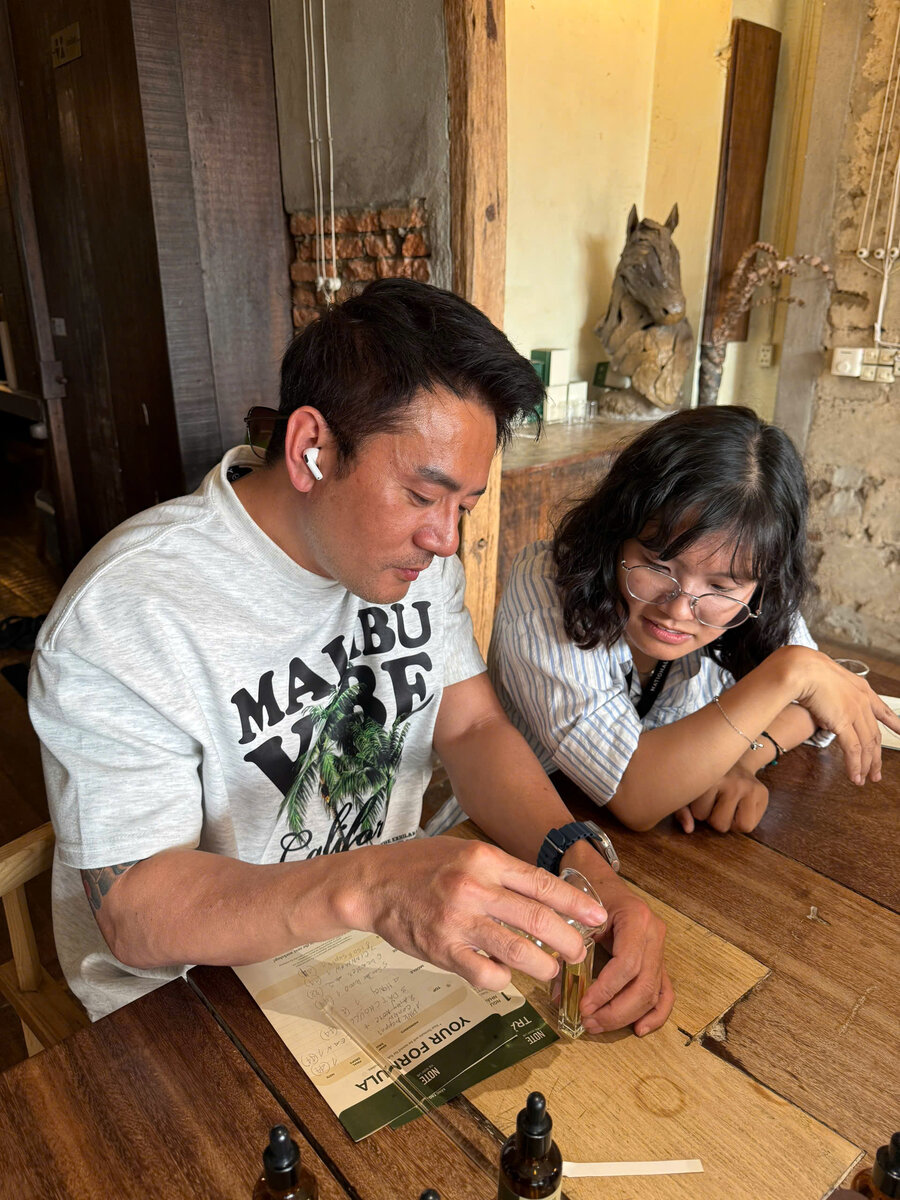
Curious what other visitors say about bottling Hanoi’s scents? Read reviews on TripAdvisor, Klook, and Google Maps.
How to find us at Lotte Mall West Lake, Hanoi (4th floor):
Frequently Asked Questions
What does Hanoi smell like?
Hanoi smells like lotus from West Lake, jasmine tea in the Old Quarter, pho broth simmering with star anise and cinnamon before dawn, agarwood incense from ancient pagodas, and hoa sữa (milk flowers) that fill every boulevard in October. Each season and neighborhood has its own distinct scent profile.
Where can I do a perfume workshop in Hanoi?
NOTE – The Scent Lab operates a 90-minute perfume workshop at Lotte Mall Tây Hồ (Store 410, 2nd Floor, 272 Võ Chí Công, Tây Hồ, Hanoi). You create a custom Eau de Parfum using 30+ Vietnamese ingredients like lotus, agarwood, and cinnamon. Rated 4.9 by 500+ travelers.
What are traditional Vietnamese fragrance ingredients?
Vietnam’s key fragrance ingredients include sen (lotus), trầm hương (agarwood), hoa lài (jasmine), sả (lemongrass), quế (Vietnamese cinnamon/cassia), and hoa sữa (milk flower). These have been used for centuries in tea ceremonies, temple rituals, traditional medicine, and artisan perfumery.
When is the best time to visit Hanoi for scents?
Autumn (September–November) is peak scent season in Hanoi — hoa sữa blooms, cốm (young green rice) appears, and the cooler air holds fragrance longer. Summer (June–August) brings lotus season on West Lake. Each season offers a distinctly different olfactory experience.
Is a perfume workshop a good rainy day activity in Hanoi?
Yes. The workshop at Lotte Mall Tây Hồ is entirely indoors, climate-controlled, and takes 90 minutes — ideal for Hanoi’s drizzly winter days or summer rainstorms. Many visitors say rainy weather enhances the experience because the humidity amplifies the fragrance ingredients.
How much does a perfume workshop cost in Hanoi?
Perfume workshops at NOTE – The Scent Lab start from VND 690,000 (approximately USD 27) for a 90-minute session. The price includes all materials, workshop instructor guidance, and a custom EDP bottle to take home. Book at workshop.thescentnote.com.
Can I recreate my Hanoi perfume after I leave Vietnam?
Your unique formula is stored by NOTE for reordering in NOTE’s system. When you return to Vietnam — or order through the website — you can have your exact Hanoi-inspired fragrance recreated.
Find NOTE – The Scent Lab
- Lotte Mall Tây Hồ (4th floor, Store 410) — Google Maps → · TripAdvisor
How to find us:
- 📍 Lotte Mall Tây Hồ — Watch direction video on YouTube →
