


NOTE – The Scent Lab is a perfume workshop in Vietnam, with locations in Saigon and Hanoi. The Hanoi store sits inside Lotte Mall West Lake (Tây Hồ), 4F, on the north side of the lake — rated ★4.9 on TripAdvisor and Google. This is one instructor’s notebook on the five scents that, more than anything else in our 30+ note palette, define a Hanoi morning. Three of them, you can blend in a bottle. Two of them, you carry home in your memory.
Nine in the morning, fourth floor, west side of the mall. I open thirty bottles. Below the window, the lake is grey-green and very still, and somewhere across the water a fish vendor is calling a price. The air conditioning hasn’t kicked in yet. The room smells faintly of the night before — sandalwood, cedar, a stranger’s perfume — and underneath that, of Hanoi.
I’m Linh. I teach perfume workshops at our Lotte Mall West Lake studio. Most weeks I run four or five sessions, mostly with international travelers, and most weeks at least one of them asks me, somewhere around the bergamot bottle: “What does Hanoi actually smell like in the morning?”
A note before you read: This guide is based on the team’s research and instructor observations as of May 2026. Prices, hours, and venue details outside the workshop change — please treat the specifics as a starting point, not a guarantee, and verify with official sources before booking.
Names of guests in this story have been changed to protect their privacy. Details of the workshop experience — the perfumes made, the studio, the conversations — are authentic.
Why Hanoi mornings smell different from Saigon mornings
Saigon wakes up the same way every day of the year: hot, humid, fast. By 7am the air is already pressing on your shoulders. You smell coffee, fish sauce, motorbike exhaust, and the river all at once.
Hanoi wakes up in seasons. That is the first thing to know.
From October to March, the city has a cool dry morning that smells of charcoal smoke and lake water. From April to September it has a humid morning that smells of jasmine and rain. Late May is somewhere in between. The thermometer might say twenty-six degrees, but the air doesn’t slap you the way Saigon does. It drifts.
This matters more than you’d think for perfume. Cold air carries scent slowly and downward. Warm air lifts it and disperses it. The same lotus pond in March and in July smells like two different ponds. The same bowl of phở at five in the morning, with a thirteen-degree breeze off the lake, is a different broth than the same recipe at noon.
So when I open my bottles in the morning at the Lotte Mall studio, I am not opening them in a vacuum. I am opening them inside whatever Hanoi has decided to do that day. After teaching five hundred or so sessions here, I have learned to listen to the city before I touch the ingredients.
Five scents come up over and over. Some weeks all five in a single session. Here they are, in the order they usually arrive in a Hanoi morning.
Scent #1: Jasmine, cooler than Saigon’s
Jasmine is the first one. It almost always is.
If you walk anywhere along Phan Đình Phùng or around the Old Quarter between six and seven in the morning, especially in the cooler months, you will catch a thin, slightly green, slightly powdery sweetness coming off the courtyard walls. That is jasmine, hoa nhài, planted as a household flower in the way other cities plant lemon trees.
It smells different here than it does in Saigon. In Saigon, jasmine is heavier — the heat pushes the indoles up, the floral goes a little animalic, almost overripe. In Hanoi’s morning cool, the same flower is restrained. Cleaner. More tea-leaf than petal. There is a reason the most beloved Vietnamese tea, scented green tea with jasmine — chè nhài, or trà nhài — is most associated with Hanoi specifically. The northern climate gives the flower its quiet voice. Hanoians have been layering jasmine into green tea for at least a century.
In our palette, jasmine is one of the workhorses. I open the bottle for almost every traveler at some point in the session. With Hanoi guests in particular, I’ll often pair it with our white musk, which softens it further toward the cooler register, and a touch of bergamot, which sharpens the top. Tea-jasmine in a bottle. Some travelers describe it that way without ever being told.
One small instructor observation from this floor: travelers from cooler northern climates — Tokyo, Seoul, the Nordics — tend to gravitate toward the lighter jasmine accord. Travelers from hotter places like Singapore and Manila often want it heavier and warmer, paired with sandalwood. Same flower. Two completely different homes for it.
“This is a not-to-miss experience! We enjoyed every moment. Vy was so helpful and taught us so much about scent pairing. I will do this again when I’m in Hanoi!”
— Seneca C, TripAdvisor ★5
Scent #2: Phở broth at five in the morning — anise, cinnamon, beef bone
The pot starts the night before. Ten kilos of beef bone, a fistful of star anise, two or three cinnamon sticks, ginger and shallot charred over an open flame, and many hours of low simmering. By 5am the broth has been working for eight or nine hours, and the front gates of the family-run phở shops along Bát Đàn or Lò Đúc start lifting.
If you stand in front of one of those shops at first light, what you smell is not “soup.” It’s a structured fragrance, with a clear arrangement: sweet warm cinnamon at the heart, slightly licorice-like star anise on the top, a marrowy savoury depth at the base, and a thread of fresh herbs — coriander, scallion, lime — coming through last. A perfumer would draw that as a pyramid. Phở Hà Nội already is one.
Hanoi phở is famously different from Saigon phở. The northern version is clearer, less sweet, less garnished. You don’t get a forest of bean sprouts and basil; you get a clean broth, slim noodles, a few thin slices of beef, and a dense aromatic top. It smells more concentrated because there is less in the bowl pulling against the broth.

And cinnamon — quế — is one of those rare cases where I can put a little of the morning into the bottle directly. We carry cinnamon from Yên Bái province, six hours northwest of where I am sitting right now. It is, by some serious distance, my favorite ingredient in our palette to introduce to Western travelers. Western perfume cinnamon tends to be the sharp, almost candy-like kind. Yên Bái cinnamon is rounder. There is a hint of woody bark behind the sweetness. It nods toward the phở pot without ever literally smelling like soup.
I had a guest last winter, Mira from Munich, who chose cinnamon as one of the three notes for her formula and could not, at the time, explain why. Halfway through the blending, she suddenly remembered: she had eaten phở at five in the morning the day before, on the second day of her trip, in a tiny shop where the only seating was plastic stools on the pavement. The cinnamon in the bottle wasn’t really cinnamon. It was that specific morning. She named her perfume after it. She still wears it, she emailed me three months later, on cold weekends back in Bavaria, when she wants to feel like she has somewhere else to be.
When you pair Yên Bái cinnamon with sandalwood, white musk, and a sliver of bergamot, you get something close to the bone of a phở morning, abstracted into a perfume. You can’t drink it. You can wear it.
Scent #3: Lotus over West Lake — June peak
From my window, I can see the southern edge of Hồ Tây, West Lake. From around mid-May through July, the lotus ponds along the western shore — Đầm Trị, the Quảng An area — go into full bloom. For about six weeks, the lake develops a smell that no other water in Vietnam quite has.
Lotus, sen, is technically a water flower with a delicate honeyed scent and a green, almost cucumber-like undertone. It does not project the way jasmine projects. You can stand a meter away from a fully open lotus bloom and barely notice it. You have to lean down. And then, suddenly, there is a quiet sweetness coming up off the petals that smells like nothing else in nature.

Hanoians have been pairing lotus with green tea, trà sen, for centuries. The classical method involves layering the tea leaves inside fresh lotus blossoms overnight, repeating for several nights, until the leaves take on the flower’s quiet sweetness. A kilo of high-grade trà sen Hồ Tây sells for the price of a small motorbike. The ritual still happens. You can find tea masters in Quảng An doing it by hand in June.
In the studio, lotus is one of the signature notes I open early in any Hanoi-themed session. It is, in fact, the one ingredient that almost every Hanoi guest gravitates toward without me having to suggest it. They pick it up, they inhale, and something quiet happens on their face. I have seen this hundreds of times. It is, I think, because the smell already lives somewhere in the city, drifting off the lake, and they have been breathing it without realising for two or three days.
Last June, a couple from Seoul — let’s call them the Jung family — came in for a workshop on a humid morning. They had been to West Lake at sunrise the day before, walked along the lotus ponds in Quảng An, taken the photographs, eaten the breakfast, done the things. When they sat down at the workshop bench, the woman picked up the lotus bottle, closed her eyes, and stayed that way for almost a full minute. She built her whole formula around it. Her husband chose differently — he went toward our cedarwood and bergamot, drier, more tailored — but on the lotus, they both agreed.
That is what scent does. It catches what you have already collected and gives it back to you in a wearable form.
“Such a fun experience — learned so much about perfume and the staff were so patient and knowledgeable, especially Sophia. Now have a great keepsake from our Hanoi trip!”
— Lucy W, TripAdvisor ★5
Book Your Hanoi Perfume Workshop →
Scent #4: Old Quarter incense at sunrise
This one I have to be honest about. It is the most distinctive Hanoi morning scent I know, and we cannot put it in a bottle.
If you walk through the Old Quarter, the thirty-six guild streets — Hàng Bạc, Hàng Mã, Hàng Đào, the rest — between five and seven in the morning, you will find that almost every household and shop has lit a thin stick of incense at the family altar. The smoke is rarely just one note. It’s a layered Vietnamese altar incense, often built around aloeswood (commonly known as agarwood, or trầm hương, in Vietnamese), a deeply resinous heartwood that is something of a national treasure, along with sandalwood, benzoin resin, and a binder. By 7am there is a faint, persistent thread of it running through the streets, especially in the alleys where the air doesn’t move.
It is at its most concentrated on the 1st and 15th of every lunar month, when offerings double across most of the temples and family altars in the city. On those mornings, the Old Quarter genuinely smells of incense the way the sea smells of salt. It is part of the air.
I should say plainly: agarwood — the famous deep, resinous, slightly damp aromatic wood at the heart of Hanoi temple incense — is not in our workshop palette. Vietnamese aloeswood is one of the most expensive raw materials on earth, and although it is part of the national fragrance vocabulary, we don’t carry it at NOTE. So I cannot hand a guest a bottle and say “this is the Old Quarter at sunrise.” The truth is, we don’t have that ingredient.
What we do have, and what works as a quiet nod, is a combination of sandalwood and cedarwood, with a careful drop of warm amber and a thread of lotus. It moves in the same general territory — meditative, slightly woody, slightly sweet — without pretending to be the same thing. Several travelers each season ask me for “something like the temple smell.” That accord is what I usually walk them through. They almost always say it reminds them of a morning they had, somewhere on their trip, without being able to point to exactly where.
You take this scent home in your memory, mostly. Some things are better that way.
Scent #5: Coffee and condensed milk vapor at seven in the morning
By seven, the lake-front cafes are open. I walk past three of them on the way up from the parking entrance, and the air outside each one is thicker than the air ten meters away. That density is coffee oil meeting steamed condensed milk, with a slow undercurrent of something almost custard-like. Hanoi coffee culture has its own chapter, and the morning vapor is the cover image.
The two scents to know are cà phê sữa đá and cà phê trứng. The first is iced coffee with sweetened condensed milk, the everyday cup, brewed slowly through a small Vietnamese filter called a phin. The second is “egg coffee,” invented in Hanoi in the 1940s when fresh milk was scarce. A whipped yolk, sugar, and condensed milk are folded together until they form a pale, foamy custard. Hot black coffee is poured underneath. The result smells of cake batter and roasted bean, simultaneously, and tastes like a dessert that didn’t know it wanted to be a drink.
What I love about cà phê trứng, as an instructor, is that it gives me something concrete to compare our gourmand notes to. We have vanilla and we have honey in the palette. Both, on their own, are quite specific. Together with white musk and a thread of sandalwood, they go somewhere unexpectedly close to the egg-coffee custard register. Not literal. Suggestive. The way a song can quote another song without copying it.
One thing I have noticed teaching here: travelers who have already had egg coffee that morning before walking up to Lotte Mall tend, three times out of five, to choose vanilla as one of their notes. They cannot always say why. The body remembers. The body picks the bottle. We follow.
“We did a perfume workshop with Vy and it was lovely. She’s very knowledgeable, kind, and helpful. I’m so happy with how my perfume turned out!”
— Thhn91, TripAdvisor ★5
From the morning city to a Hanoi perfume workshop
People sometimes ask whether teaching at Lotte Mall — a glass-and-steel international shopping centre — feels disconnected from the older Hanoi I have just been describing. It doesn’t. The studio is fifteen minutes by taxi from Quảng An lotus ponds, twenty minutes from the Old Quarter incense streets, ten minutes from the cafes along Tô Ngọc Vân. Travelers come up the elevator carrying the city on their clothes. We can smell it before they sit down.
That is, in fact, how most of our best workshops in Hanoi begin. A guest has been out walking since 6am. They have eaten phở on a plastic stool. They have stopped for an egg coffee. They have wandered through Quảng An and stood at a lotus pond. They have walked through the Old Quarter and noticed a thread of incense smoke turning a corner. By the time they sit down at our bench at 10:30 — coffee in hand, hair still slightly damp from the lake humidity — the morning has done most of the work for me.
Mikhail came up to the studio one summer, a Russian traveler in town for a week. He told me at the start of the session that he wanted to make “a one-and-only” perfume, his signature, and that he already knew what he liked in the perfumes he wore at home — clean, oceanic, slightly cool. We started there. But he had been at West Lake at sunrise, and he had stopped at a lotus pond on the way. By the second round of blending, he had quietly added bergamot and wet amber to his ocean and apricot accord, and the whole formula tilted slightly Hanoi-ward. He named his bottle after the morning, not after himself. He wears it on cold mornings in Moscow now, he wrote later. It works there too. Hanoi traveled.
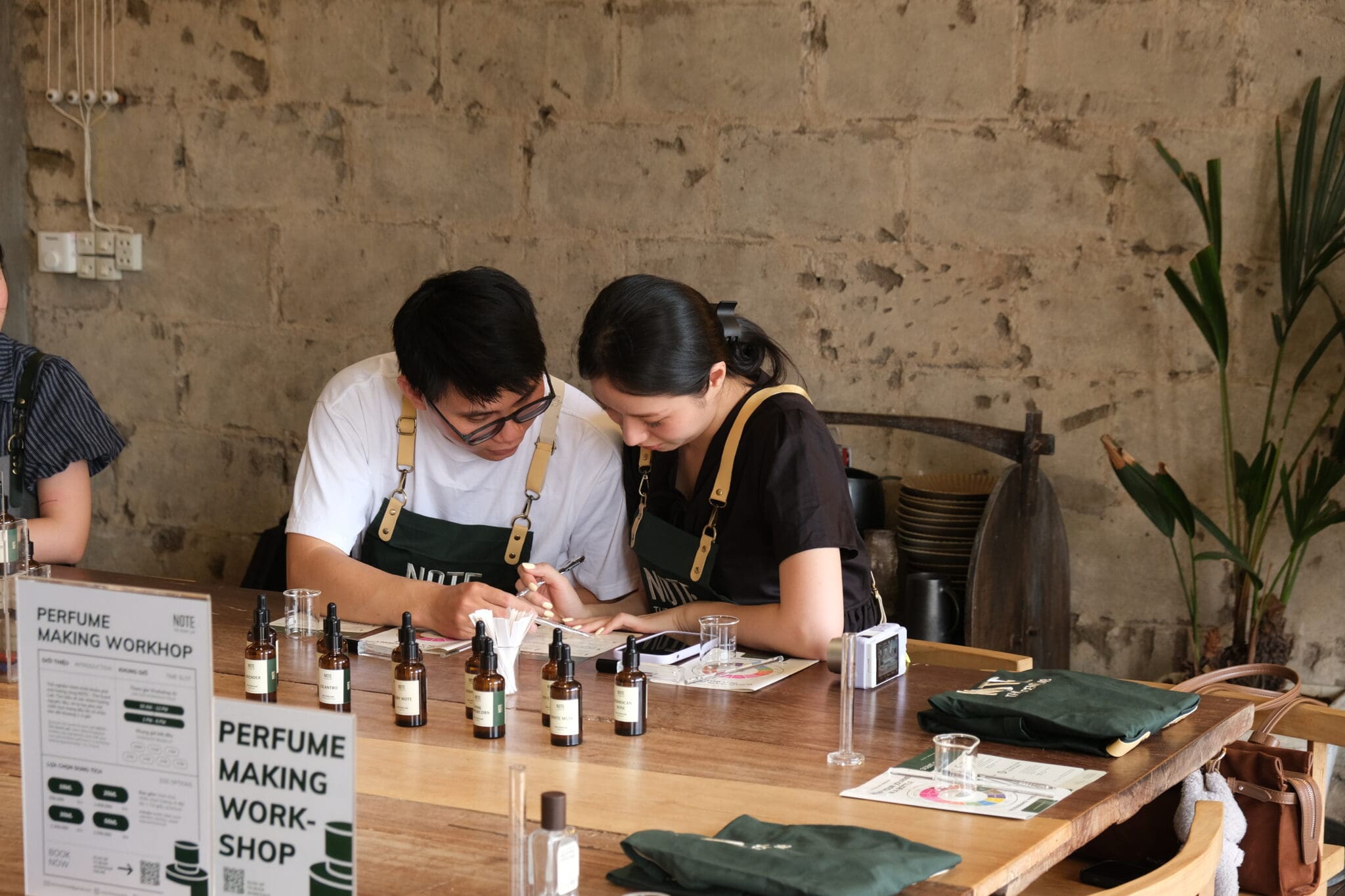
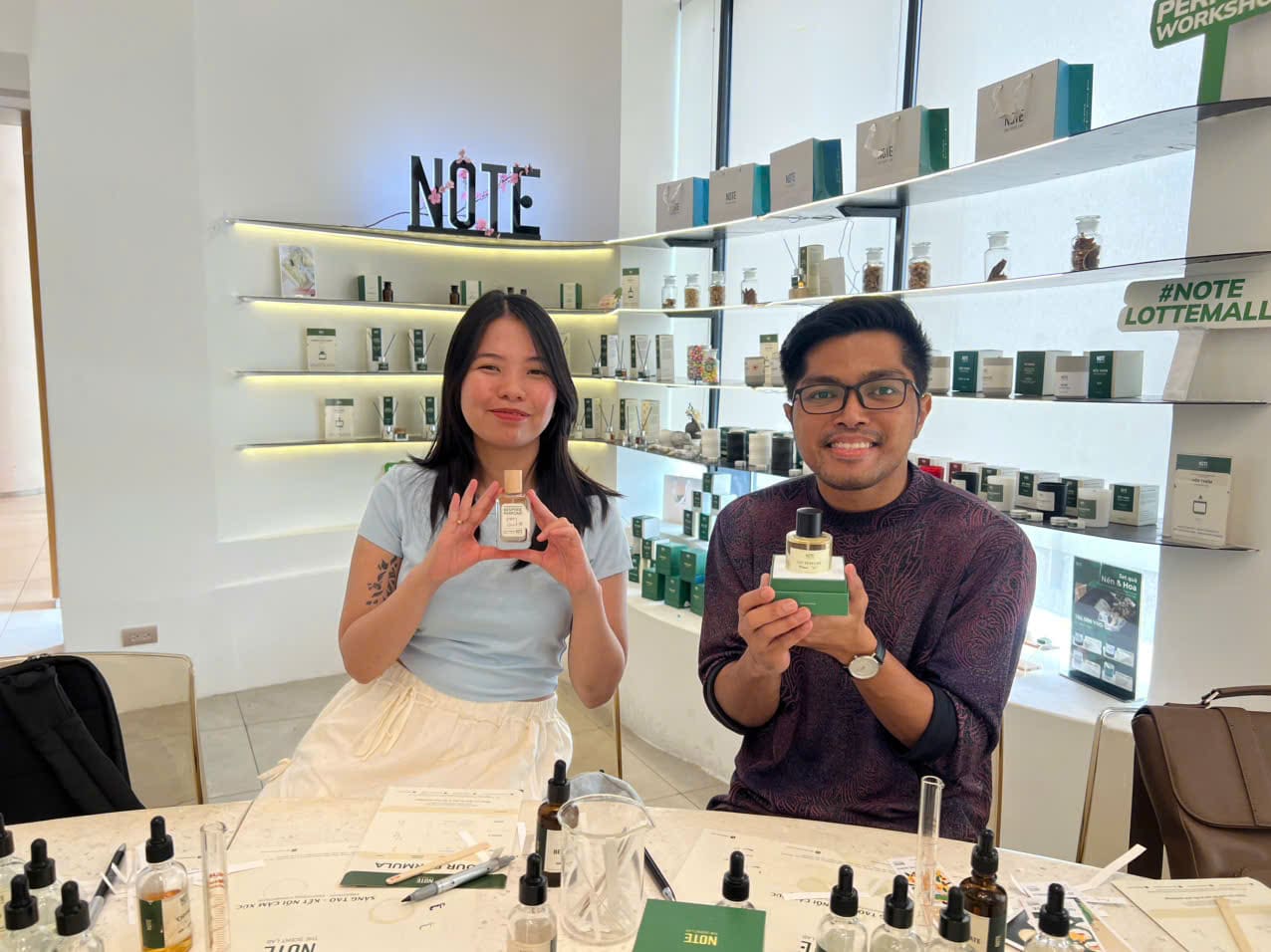
A NOTE workshop runs 90 to 120 minutes, hands-on, with an expert instructor. We work from 30+ fragrance notes, IFRA-certified, including Vietnamese specialties — lotus from West Lake, jasmine, sandalwood, cinnamon from Yên Bái, lemongrass, and more. Workshop tiers start at $24 (10ml) and go up to $64 (50ml), or roughly 550,000 to 1,550,000 VND. Each guest leaves with a finished perfume bottle, a take-home formula card so we can recreate the scent for you later if you wish, a sealed gift box, and a complimentary leak-protection zip pouch designed for cabin pressure on long flights home. There is no certificate; we are not pretending you graduated from a program. You spent a morning making a perfume.
If this article has reached you while you are still planning your trip, our instructor’s regional guide to the scent of Vietnam covers what differentiates north from south, and why those differences matter at the workshop bench. If you are interested in the southern counterpart — Saigon’s temple incense, which sits in a different aromatic family — our Jade Emperor Pagoda piece goes deep on agarwood and sandalwood as cultural ingredients. And for everything you need to know about the Hanoi store specifically — directions, parking, hours, what to expect — see our complete guide to NOTE at Lotte Mall West Lake.
A souvenir, or two scents you cannot bottle
Three of these five scents, you can carry home. The jasmine, the cinnamon, the lotus — all of those, in some configuration, can sit in your bottle. We can build a Hanoi morning around them, and you can spritz a little of it on a Tuesday in your own kitchen and remember the lake.
The other two, you cannot. The Old Quarter incense at sunrise is its own ingredient, and we don’t carry it. The egg-coffee vapor at seven needs the cup itself, and the sweat of the cafe windows, and the walk you took to get there. Those scents are not portable.
That is, I think, fine. Maybe even better than fine.
Our retail collection at thescentnote.biz includes a few ready-made Vietnamese-ingredient perfumes, a soft alternative if a 90-minute workshop doesn’t fit your itinerary. They are quieter than a custom workshop blend, but they hold the same vocabulary — lotus, jasmine, sandalwood, vanilla, the things this notebook keeps coming back to. If you’d rather not build, you can borrow.
Five scents make a city. We can capture three of them in a bottle. The other two — you take with you in memory. Most travelers tell me, months later, that those are the ones that stay.
Book Your Hanoi Perfume Workshop →
Frequently Asked Questions
What does Hanoi morning smell like?
Hanoi morning is layered. In a single early-morning walk you can pick up jasmine from the courtyards, the warm cinnamon-and-anise top of a phở pot, lotus drifting off West Lake (especially May–July), thin altar incense in the Old Quarter, and condensed-milk coffee vapor outside the lake-front cafes around seven. Cool dry air from October to March keeps these scents close to the ground; humid air from April to September lifts them and disperses them. Same city, two different smells depending on the season.
Where can I make a Hanoi-inspired perfume?
NOTE – The Scent Lab runs a perfume workshop on the 4th floor of Lotte Mall West Lake (Tây Hồ), at 272 Võ Chí Công, Hanoi. Sessions run 90–120 minutes, hands-on, with an expert instructor and 30+ IFRA-certified fragrance notes including Vietnamese specialties like lotus, jasmine, and Yên Bái cinnamon. Workshops start at $24 (10ml) and go up to $64 (50ml). Booking is at workshop.thescentnote.com/book/.
What’s the most distinctive Vietnamese scent ingredient available at the workshop?
For Hanoi specifically, the two most distinctive Vietnamese ingredients in our palette are West Lake lotus (sen) and Yên Bái cinnamon (quế). Lotus carries a quiet, honeyed, green-cucumber sweetness associated with the lotus tea tradition of Quảng An, on the western edge of West Lake. Yên Bái cinnamon is a rounder, less candy-like cinnamon than Western perfumery often uses — it nods toward the spice top of Hanoi phở broth without literally smelling like soup.
How does Hanoi smell different from Saigon?
Saigon mornings are hot, humid, and fast — you smell coffee, fish sauce, motorbike exhaust, and the river at the same time. Hanoi mornings are cooler and seasonal, especially from October to March. The cool dry air keeps scents close to the ground, so you tend to notice them in layers: jasmine first, phở broth second, lotus over the lake third. Saigon’s heat presses scents flat. Hanoi’s coolness arranges them in a sequence. Phở itself is a clean example: northern phở is clearer and more aromatic; southern phở is sweeter and more garnished.
Where is the NOTE perfume workshop in Hanoi?
The Hanoi store is at Store 410, 4F, Lotte Mall West Lake (Lotte Mall Tây Hồ), 272 Võ Chí Công, Tây Hồ District, Hanoi. The mall is on the north side of West Lake, about 15 minutes by taxi from the Old Quarter and 20 minutes from Hoàn Kiếm Lake. The studio sits on the fourth floor, with a window onto the lake. Most international travelers reach us by Grab or hotel taxi.
What time of day is best for experiencing Hanoi scents?
Five to seven in the morning is the densest stretch. The phở pots are at their most aromatic just before the breakfast rush; the Old Quarter incense is most concentrated before traffic builds; the lake-front cafes are firing up the first batch of egg coffee; and the lotus ponds, in season, are at their most fragrant before the sun gets onto them. By 9am the city is moving, the air is starting to warm, and most of the morning fragrance has lifted away. For perfume-minded travelers, the early walk pays off.
Is there a perfume workshop near West Lake?
Yes — NOTE at Lotte Mall is the closest perfume workshop to West Lake, sitting on the fourth floor of Lotte Mall West Lake on the lake’s north shore. From the lotus ponds at Quảng An, the studio is about a 10-minute drive. Many travelers come straight from a sunrise walk along the lake into a 10:30am or 1pm workshop session.
Do I need to book in advance?
Booking ahead is recommended, especially in peak tourist months from October to April. Sessions can fill up several days in advance during weekends and Vietnamese holidays. Walk-ins are sometimes possible mid-week, but a quick booking the day before through workshop.thescentnote.com/book/ is the safer bet.
This article is provided for general informational and reference purposes only. Information was accurate at the time of writing (May 2026) but may change without notice. Opening hours, prices, transit schedules, and availability for venues outside NOTE – The Scent Lab can change. Please verify with official websites, TripAdvisor, or Google Maps before your visit. We do not guarantee accuracy and are not responsible for outcomes based on outdated information.
Find NOTE – The Scent Lab
- Lotte Mall West Lake (Hanoi) — Store 410, 4F, 272 Võ Chí Công, Tây Hồ District, Hanoi — Get directions → · TripAdvisor
- 42 Nguyễn Huệ (Saigon — Cafe Apartment, Floor 3 / Lầu 2) — Get directions → · TripAdvisor
- 34 Nguyễn Duy Hiệu (Saigon — Thảo Điền, Thủ Đức) — Get directions → · TripAdvisor
How to find us:
- 📍 Lotte Mall Hanoi — Watch direction video on YouTube →
Follow the day-to-day at the studio on Instagram @note.workshop.
