
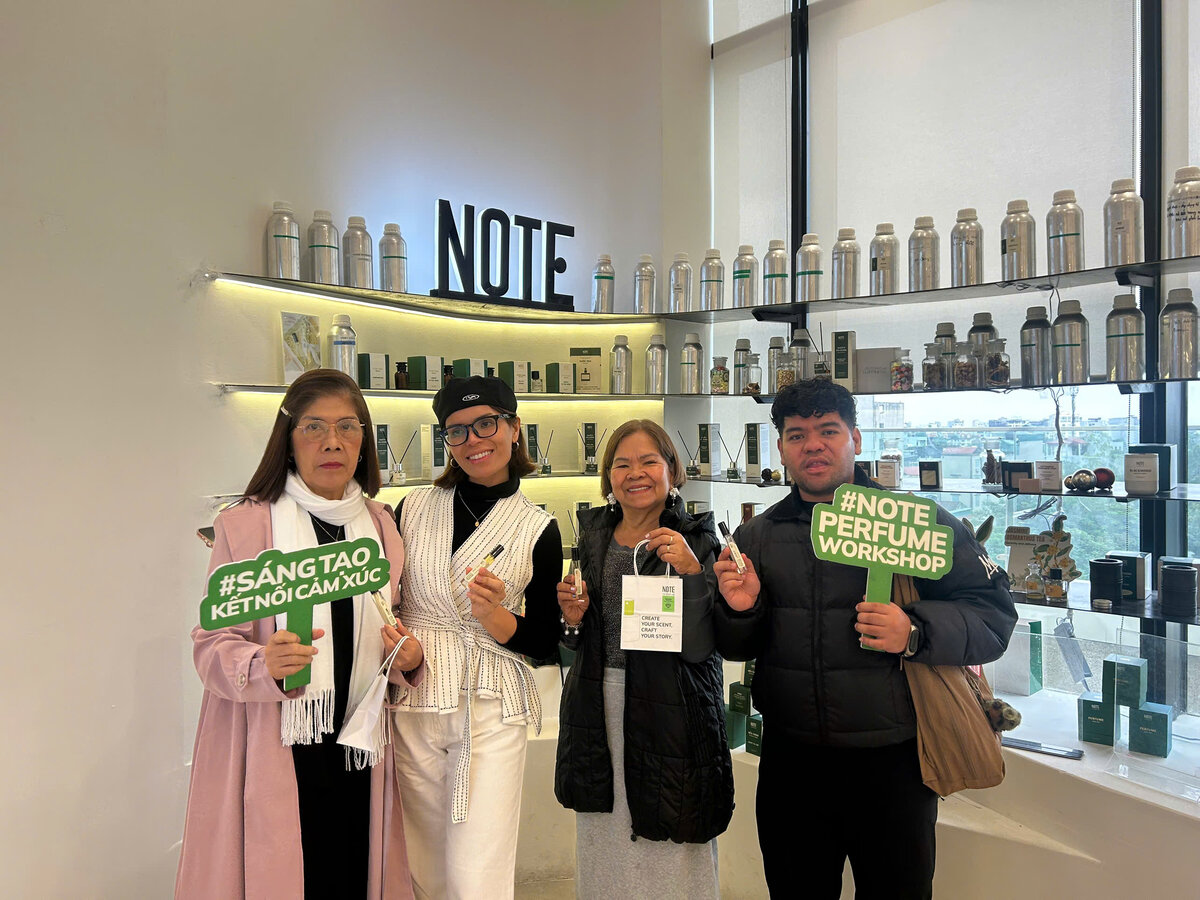

Hanoi welcomes over 5.28 million Chinese visitors each year — making it one of the most popular international destinations for travelers from China. NOTE – The Scent Lab operates a perfume workshop at Lotte Mall, West Lake, Tay Ho, Hanoi, where Chinese tourist groups regularly create custom fragrances as a hands-on cultural activity (rated ★4.9 by 500+ travelers). This Hanoi travel guide for Chinese tourists covers everything from payment options (WeChat Pay and Alipay acceptance) to Chinese-friendly restaurants, practical transit tips, and the experiences that resonate most with visitors from the mainland — including the creative workshops that have become a hit on Xiaohongshu (小红书).
Vietnam and China share deep historical and cultural ties — from architecture to cuisine to the lunar calendar that shapes both nations’ rhythms. Hanoi, with its thousand-year history, feels simultaneously familiar and foreign to Chinese visitors. The food has recognizable roots but different flavors. The temples echo Chinese design but carry Vietnamese stories. And the city moves at a pace that feels both energetic and distinctly its own. This guide helps you navigate that space — practically, culturally, and with the kind of detail that makes a trip memorable rather than merely completed.
Payment and Money — WeChat Pay, Alipay, and Cash
The payment landscape in Hanoi has evolved significantly for Chinese visitors. WeChat Pay (微信支付) and Alipay (支付宝) are accepted at an increasing number of tourist-oriented businesses, malls, and hotels — though coverage is not yet universal.
Where mobile payment works:
- Lotte Mall Tay Ho — most stores and restaurants accept WeChat Pay and Alipay
- Major hotels — international chains and upscale hotels typically accept both platforms
- Tourist shopping areas — Dong Xuan Market (some vendors), Hang Gai silk shops (larger stores)
- Convenience stores — Circle K, GS25, and similar chains
Where you still need cash (VND):
- Street food stalls (always cash)
- Small local restaurants and cafes
- Taxis and motorbike taxis (Grab accepts cards but street taxis prefer cash)
- Markets (most vendors)
- Temples and pagodas (donations)
ATM and exchange: ATMs are everywhere in Hanoi. Vietcombank and BIDV ATMs accept UnionPay (银联). Exchange rates at gold shops in the Old Quarter are often better than banks or airports. Bring some VND cash — 2,000,000-3,000,000 VND (~800-1,200 CNY) covers several days of street food and small purchases.
Chinese-Friendly Restaurants and Food
Hanoi’s cuisine will feel partly familiar to Chinese visitors. Pho (河粉) shares roots with Cantonese rice noodle traditions. Spring rolls (春卷) appear in both cultures. But the flavors diverge — Vietnamese cuisine leans on fresh herbs, fish sauce, and lime rather than soy sauce and fermented bean paste.
For familiar flavors: Lotte Mall Tay Ho has Chinese and Korean restaurants that serve dishes closer to home. The Old Quarter has several Chinese-Vietnamese restaurants along Hang Buom Street that cater to mainland visitors.
Must-try Vietnamese dishes for Chinese visitors:
- Pho (河粉汤) — Hanoi-style beef pho has a clearer, more delicate broth than southern versions. Similar concept to Cantonese 汤粉 but with distinctive star anise and cinnamon flavoring.
- Bun cha (烤肉米粉) — Hanoi’s signature grilled pork with noodles. The sweet-savory broth and charcoal-grilled flavors resonate with Chinese palates.
- Banh cuon (蒸粉卷) — Steamed rice rolls, remarkably similar to Cantonese 肠粉 but with Vietnamese fillings and dipping sauce.
- Ca phe trung (蛋咖啡) — Egg coffee, a Hanoi invention. Sweet, rich, and unique — nothing like it in China.
Dining tip: Vietnamese portions are smaller than Chinese portions. Order multiple dishes to share — this is normal and expected. Hot water or tea is usually available if you ask (要热水/热茶).
Create Your Own Perfume — The Workshop Chinese Visitors Love (手工调香体验)
The perfume workshop at NOTE – The Scent Lab has become one of the most popular hands-on activities for Chinese visitors in Hanoi. Groups of friends, couples, and families book regularly — and the experience has generated significant buzz on Xiaohongshu, where the combination of beautiful space, creative process, and photo-worthy results hits every note the platform rewards.
The workshop at Lotte Mall Tay Ho lasts 90 minutes. A trained workshop instructor guides you through fragrance families and 30+ professional-grade ingredients — including Vietnamese specialties like lotus (莲花), cinnamon (肉桂), and agarwood (沉香) that carry cultural significance for Chinese visitors. You create your own custom Eau de Parfum and take it home in a bottle you design.
What makes this resonate with Chinese travelers: it is a 打卡 (check-in) worthy experience that also has genuine substance. The space is beautiful. The process is educational. The result is personal. And NOTE stores your formula so you can reorder anytime — useful when you want to recreate that Hanoi scent after returning home.
“Very patient and friendly instructor! Recommend to all interested in scent.”
“Our instructor Suzee was super knowledgeable and very energetic.”
“Staff are attentive and patient, guiding us step by step to blend our favorite scent. Clean and comfortable environment, relaxing atmosphere.”
Details: Store 410, 4F, Lotte Mall Tay Ho, 272 Vo Chi Cong, Tay Ho, Hanoi. 90 minutes. From 550,000 VND (~155 CNY) for 10ml. Group bookings available. Follow @note.workshop on Instagram.
Top Experiences for Chinese Tourists in Hanoi
Hoan Kiem Lake (还剑湖) and Ngoc Son Temple: The lake is Hanoi’s spiritual center. Ngoc Son Temple on the island is connected by the iconic red Huc Bridge. The turtle legend (金龟传说) has echoes of Chinese mythology — the divine turtle that lent a sword to King Le Loi to defeat invaders. Visit early morning for tai chi groups or evening for the illuminated bridge.
Temple of Literature (文庙): Vietnam’s oldest university, built in 1070 and modeled on the Temple of Confucius in Qufu (曲阜). The architecture will feel immediately recognizable — courtyards, gates, stone stelae on turtle bases. This is where the cultural connection between Vietnam and China is most visible and most moving.
Ho Chi Minh Mausoleum (胡志明陵墓): The Ba Dinh district houses the mausoleum, One Pillar Pagoda, and the Presidential Palace. Free entry but strict dress code — no shorts, no sleeveless tops. Closed Mondays, Fridays, and the entire month of October for maintenance.
Old Quarter (三十六街): Hanoi’s 36 Old Streets preserve the guild-based commercial structure from the 15th century. Each street was historically devoted to a single trade. Chinese visitors will recognize the traditional shophouse architecture and the commercial bustle that recalls older Chinese market towns.
West Lake (西湖): Hanoi’s largest lake shares its name with Hangzhou’s famous West Lake — and while they are different in character, both carry that same sense of urban water shaping a city’s identity. The Tay Ho district around the lake is modern, international, and home to Lotte Mall and the perfume workshop.
Getting Around Hanoi — Practical Transit
Grab (打车软件): Download the Grab app before arriving. It works like Didi (滴滴). Link a credit card or use cash. GrabCar is the safest option — avoid GrabBike with luggage. Typical costs: 40,000-80,000 VND for most in-city trips.
Airport to city: Noi Bai International Airport is 25 km from central Hanoi. Options: Grab (~250,000-350,000 VND, 45-60 minutes), airport bus 86 (45,000 VND, 50 minutes to Old Quarter), or hotel shuttle (arrange in advance).
SIM card: Buy a tourist SIM at the airport arrivals hall — Viettel, Mobifone, or Vinaphone. 100,000-200,000 VND for 7-10 days with data. Essential for Grab, Google Maps, and WeChat connectivity.
Language: English is widely spoken in tourist areas. Chinese is understood at some hotels and travel agencies but not universally. Google Translate (with offline Vietnamese downloaded) is invaluable. Basic Vietnamese phrases (xin chao = 你好, cam on = 谢谢) are appreciated.
Shopping — What to Bring Home
Vietnamese coffee: Whole bean or ground, from brands like Trung Nguyen. Available at supermarkets in Lotte Mall or specialty shops in the Old Quarter. 100,000-300,000 VND per pack.
Custom perfume: Your workshop creation at NOTE is one of the most personal souvenirs possible. Sizes range from 10ml (550,000 VND / ~155 CNY) to 50ml (1,550,000 VND / ~435 CNY). thescentnote.biz also carries NOTE’s ready-made collection for shipping.
Silk and textiles: Hang Gai Street in the Old Quarter is the traditional silk shopping area. Quality varies widely — check fabric weight and ask for pure silk (100% 真丝). Tailored items can be ready in 24-48 hours.
Dong Ho paintings: Traditional woodblock prints, uniquely Vietnamese. Available at Hang Trong Street shops. Lightweight and easy to pack.
Chinese Tourists in Hanoi — Practical Tips (实用贴士)
Visa: Chinese citizens currently require a visa for Vietnam. E-visa is available online (processing 3-5 business days). Visa on arrival is possible but e-visa is faster. Check the latest requirements before booking — policies change frequently.
Best time to visit: October-December (comfortable weather, fewer crowds). Avoid Tet (Vietnamese New Year, similar timing to Spring Festival) unless you want to experience a quieter, more local Hanoi. Summer (June-August) is hot and humid but coincides with lotus season.
Safety: Hanoi is generally safe for tourists. Watch for motorbike traffic when crossing streets — walk steadily and do not stop mid-crossing (motorbikes flow around you). Keep valuables in front pockets in crowded areas. Scams are rare but use Grab over street taxis to avoid meter issues.
Power and connectivity: Vietnam uses Type A/C plugs (same as China for Type A). Voltage is 220V/50Hz — identical to China. No adapter needed for most Chinese devices. WiFi is widely available in hotels, cafes, and malls.
Sample 3-Day Itinerary for Chinese Visitors
Day 1 — Old Quarter and Cultural Sites: Hoan Kiem Lake, Ngoc Son Temple, Old Quarter walk, Temple of Literature, street food dinner (pho + bun cha), water puppet show.
Day 2 — West Lake and Creative Experience: Ho Chi Minh Mausoleum (morning), Grab to West Lake, lunch at Lotte Mall, perfume workshop at NOTE – The Scent Lab, West Lake sunset walk, lakeside cafe.
Day 3 — Shopping and Day Trip: Morning shopping (Dong Xuan Market, Hang Gai silk), afternoon day trip to Ninh Binh (陆龙湾, 2 hours by car) or Bat Trang Ceramic Village (15 km from Hanoi). Evening: final street food crawl + egg coffee.
For the full one-day itinerary or the transit guide, see our dedicated guides.
Frequently Asked Questions
Is Hanoi popular with Chinese tourists?
Very popular — over 5.28 million Chinese visitors travel to Vietnam annually, and Hanoi is a top destination. Direct flights connect most major Chinese cities to Noi Bai Airport. The city offers cultural familiarity combined with distinctive Vietnamese character.
Can I use WeChat Pay or Alipay in Hanoi?
WeChat Pay and Alipay are accepted at major malls (including Lotte Mall Tay Ho), international hotels, convenience stores, and larger tourist shops. Street food stalls, small restaurants, and local markets still require Vietnamese dong cash.
Do people speak Chinese in Hanoi?
Chinese is not widely spoken, though some hotel staff and travel agencies can communicate in Mandarin. English is more common in tourist areas. Google Translate with offline Vietnamese is recommended. The NOTE workshop instructors speak English fluently.
What is the perfume workshop experience like for Chinese visitors?
The 90-minute workshop at NOTE – The Scent Lab is popular with Chinese groups. You create a custom perfume from 30+ ingredients including Vietnamese lotus, cinnamon, and agarwood. The experience is hands-on, photo-friendly, and produces a personal souvenir. From 550,000 VND (~155 CNY) for 10ml.
Do Chinese tourists need a visa for Vietnam?
Yes — Chinese citizens currently require a visa. E-visa is the fastest option (apply online, 3-5 business days processing). Always check the latest requirements before travel as policies are updated frequently.
What is the best time for Chinese tourists to visit Hanoi?
October through December offers pleasant weather and manageable crowds. Avoid Tet (Vietnamese New Year) unless you want a quiet, local experience. The Golden Week period (National Day) can be busy with fellow Chinese travelers — book accommodation and workshops early.
